Faculty researchers win new NIH funding
January 5, 2026
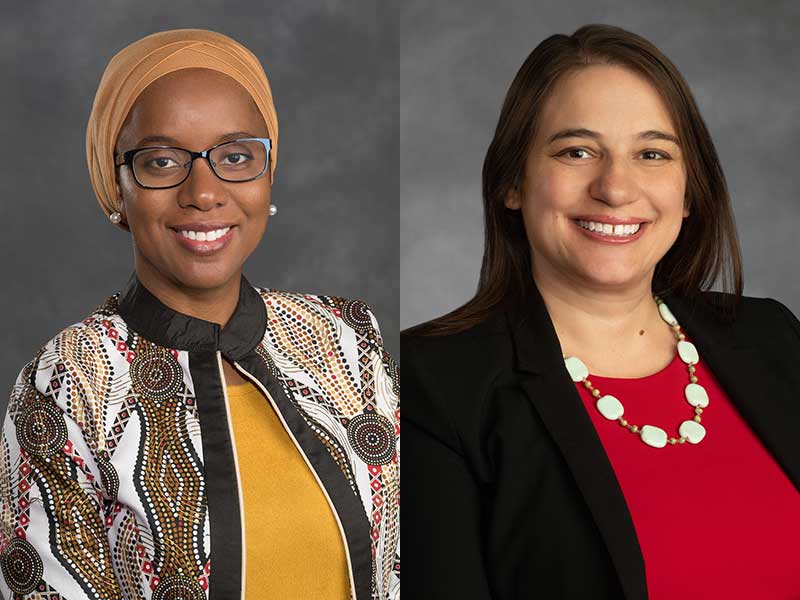
The simplest things in life can sometimes be the most complicated, from access to healthy food to sharing family health history. Thanks to recent NIH funding, two VCU School of Nursing early career faculty researchers are one step closer to helping make things simpler and healthier for patients.
“Please join me in congratulating two of our faculty researchers on their NIH funding awards,” said Patricia Kinser, Ph.D., RN, WHNP-BC, FAAN, dean of the VCU School of Nursing. “Dr. Lisa Shah and Dr. Ana Diallo are rising stars and at the forefront of using innovative strategies for ensuring wellness. By removing the barriers often associated with discussing clinical genetic data, Dr. Shah is testing a technology that ensures that vital health insights are not just stored in a medical record but are actively understood and shared among family members. By removing barriers to accessing healthy foods, Dr. Diallo’s work will drive real-time preventive care and better health outcomes across populations."
Ana Diallo, Ph.D., M.P.H., RN, assistant professor in the Department of Adult Health and Nursing Systems and Building Interdisciplinary Research Careers in Women’s Health Scholar, received NIH funding to address health inequities among the communities we serve.
Implemented through the School of Nursing’s Mobile Health and Wellness Program, the Prescription Produce Program not only provides patients with healthy fruits and vegetables every week, nutrition counseling and health checks, but also screening for other social needs including financial, housing and food insecurity.
It’s not realistic, as a public health nurse, to talk to someone about healthy eating if they don’t have access to food, if they don’t have stable housing. But that’s changing thanks to nurse researchers, nursing visionaries and results that show impact.
Ana Diallo, Ph.D., M.P.H., RN
“It makes so much sense, but it took a lot of work,” she explains. “It took a lot of buy-in from the leadership at the School of Nursing to really say, ‘this is impactful, this is meaningful’ and help craft this important story so that more folks and funding comes through.”
The recent NIH award allows Diallo to pilot the program solely for those enrolled in the diabetes prevention program.
“I’m living my dream here. I can use my knowledge to make an impact,” Diallo says. “I’m so grateful for my mentors, the faculty and the leadership at the school for their support of nursing research.”
Lisa Shah, Ph.D., RN, assistant professor in the Department of Adult Health and Nursing Systems, has always been interested in genetics and family connections. It’s not surprising then, that her recently NIH-funded project is all about family information sharing.
“As a bedside nurse at the Mayo Clinic, I took care of adults and kids with heart conditions recovering from surgery,” Shah says. “One of my patients at the time was from Texas. His son came in a year later. You really see family connections with these conditions.”
During her Ph.D. program, Shah began to focus on how families communicate genetic information.
“I was really interested in how we take care of people with genetic conditions,” she remembers. “How do families communicate this information? It’s really hard.” Even in her own family, from her mother’s breast cancer to a cousin’s cancer.
“My mom would tell me anything I wanted to know. She was a great communicator and would do her best to tell me. She had breast cancer. Was it triple negative? I don’t know.”
All the guidelines, she explains, say cascade testing is recommended, but those few little words represent a lot of work.
It means that the person who just got diagnosed now has to deliver this information about their condition to all of their at-risk relatives. They need to know who’s at risk. They need to tell them in a way that convinces them to go get tested and screened.
Lisa Shah, Ph.D., RN
Shah’s NIH-funded work is designed to improve communication and management of genomic and familial health history through easy-to-use web-based technology. This integration of innovative technology is particularly impactful because it democratizes access to complex genetic information, empowering families—regardless of health literacy—to make proactive, life-saving decisions that might otherwise be out of reach.
Both Shah and Diallo are helping to remove obstacles for patients so that they can get back to the simpler things in life. Removing these obstacles also helps patients ensure their families stay healthy.
“Research is hard work and requires dedication, passion and patience,” Dean Kinser says. “The support of NIH funding helps our researchers improve patient outcomes and transform healthcare in a community-engaged way. Dr. Ana Diallo and Dr. Lisa Shah have created programs of research with the potential for significant impact on long-term health and wellness for our patients, families, and communities.”